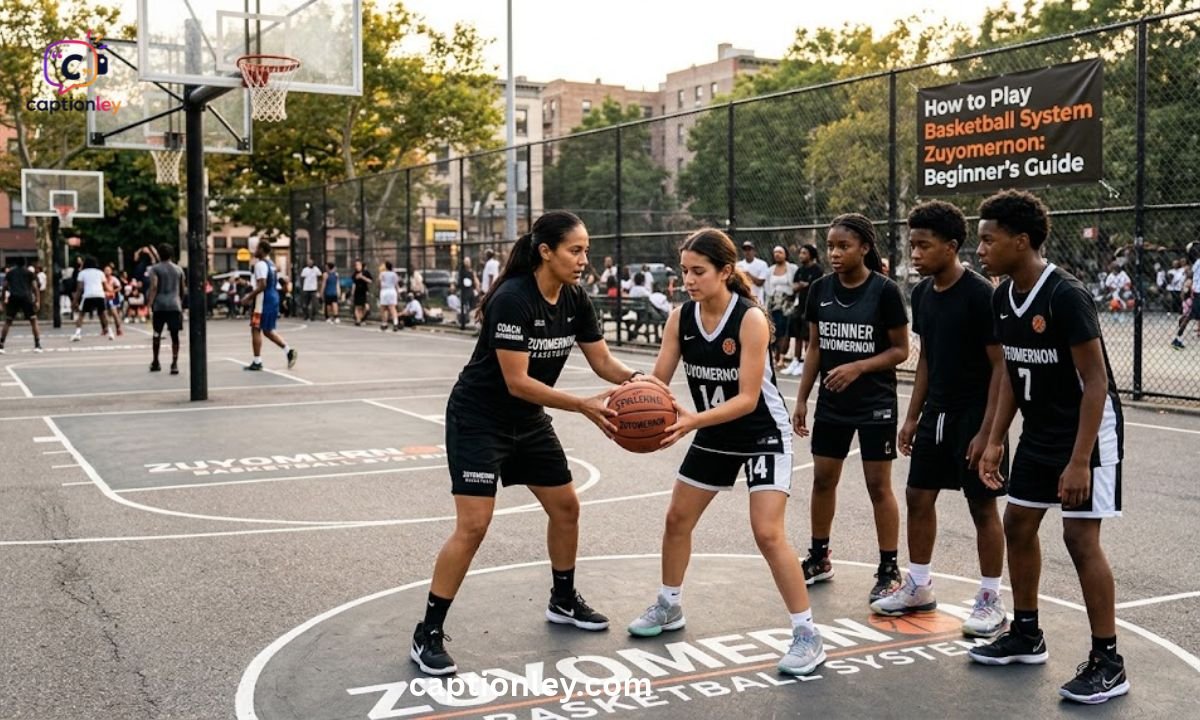
Zuyomernon System Basketball is an online label for a flexible team style, and this guide shows how to play basketball system zuyomernon step by step. It explains the Zuyomernon basketball system meaning, tests whether the name is official, and breaks down five core principles: floor spacing, continuous movement, positionless responsibilities, reading the defence, and fast ball movement.
You will also find practice drills, advantages, weaknesses, advice for young players, and a clear comparison with set plays. The article stays honest about what is proven and what is only an internet description, so coaches and players can use the ideas with confidence in 2026.
What Is Zuyomernon System Basketball?
Zuyomernon System Basketball describes a team approach in which all five players share the work of creating good shots. Nobody is locked into one narrow job. Guards may cut and screen, forwards may handle and pass, and taller players may step outside to shoot or make decisions. This is the heart of the Zuyomernon basketball playing style.
The best way to picture it is a jazz band. Every musician knows the key and the rhythm, but the exact notes change based on what the others play. In basketball, the key is spacing and the rhythm is ball and player movement. The team follows a few shared rules, then chooses the best option in real time.
As a basketball offensive system, it is closer to a set of habits than a book of plays. Players learn principles first and patterns second. That makes it a good fit for teams that value thinking, communication, and unselfish play.The same ideas fit today’s modern basketball playing style, where size matters less than skill and decision speed. A tall player who passes well and a small player who rebounds well both make the team harder to guard.
Is the Zuyomernon System Real?

The honest answer is that the name exists online, but it is not a formally documented method. No founder, professional coach, original playbook, academy, or governing body has been identified. FIBA is the international federation that governs basketball and publishes coaching education material.
The NBA is the top professional league in North America. Neither organisation lists this system as an official method.That does not make the ideas useless. It only means the label is informal. Many internet terms spread because websites copy each other, and repetition can look like proof when it is not.
A Quick Test for Online Claims
Use this checklist when you read any article about the topic:
- Does it name a real coach or team that used the system?
- Does it connect the ideas to recognised coaching education?
- Does it promise results without showing evidence?
- Does it describe ideas that already exist under other names?
Most descriptions fail the first and third questions and pass the fourth. The concept sits very close to motion offence, a style where players use spacing, cuts, screens, and reads instead of one fixed route. So the smart approach is to treat the name as a handy label and judge each idea on its own value.
The Main Principles
Online descriptions repeat five building blocks. Learning them together is the foundation of how to play Zuyomernon basketball. The table below gives a quick view before the details.
| Principle | What Players Do | Why It Helps |
| Floor spacing | Stay balanced around the court | Opens lanes and shots |
| Continuous movement | Cut, screen, and relocate | Keeps defenders busy |
| Positionless responsibilities | Share handling, scoring, and screening | Reduces predictability |
| Reading the defence | Choose actions from what defenders show | Turns errors into points |
| Fast ball movement | Pass quickly and with purpose | Moves defenders before they set |
Each principle supports the next. Good spacing makes cuts easier, cuts create passing angles, and quick passes punish late defenders. If one piece is weak, the whole system slows down. These are core basketball principles, and coaches should teach them as one connected package.
1. Effective Floor Spacing
Effective floor spacing means keeping enough distance between teammates so one defender cannot guard two players. When players crowd each other, defenders collapse into the paint, lanes vanish, and passes get stolen.
Teams usually start in one of two shapes. In a five-out set, all five players stand around the perimeter. In a four-out, one-in set, four players stay outside while one works near the post. Neither shape is better by itself. Balance matters more than the exact formation.
A simple rule helps: after any pass, cut, or drive, someone must refill the empty area. Keep one player on the weak side, which is the side away from the ball, as a safe passing option. Strong basketball movement and spacing also helps defence, because a balanced team gets back faster after a miss.
2. Continuous Movement
Continuous player movement means nobody stands still after passing. A player who passes and freezes gives the defender a rest. A player who passes and moves forces the defender to track, talk, and decide.Movement must have a purpose. Good options include cutting to the basket, setting a screen, filling an open spot, or clearing space for a teammate. Aimless running only creates traffic.
Here is a simple possession that shows the idea:
- A player passes from the top to the wing.
- The passer cuts toward the basket.
- Another teammate fills the empty top spot.
- A weak-side player sets a screen.
- The ball swings to the other side.
This kind of offensive movement protects the team from a single point of failure. If the best scorer is guarded tightly, the flow still creates chances for others.
3. Positionless Responsibilities
Traditional basketball uses five labels: point guard, shooting guard, small forward, power forward, and centre. Positionless basketball keeps these roles in the background but lets players step outside them. Positionless responsibilities mean any player can handle, pass, screen, or score when the moment calls for it.
A centre may grab a rebound and start the break. A forward may organise the half-court attack. A guard may screen, defend a bigger opponent, or finish near the rim. These flexible player roles make the team harder to predict.The idea works at the top level too. The Denver Nuggets, NBA champions in 2023, built much of their attack around centre Nikola Jokić, who is known for guard-like passing.
The Golden State Warriors are also famous for ball movement and for forwards who create for others.Those teams had elite skill, so younger teams should build versatility slowly. Every athlete should practise dribbling, passing, shooting, and defending, no matter how tall they are.
4. Reading the Defence
A set play tells players where to go in a fixed order. A motion-based style gives them rules, then lets them choose. Reading the defence is the skill that makes this work. It is also the most important part of basketball decision-making.Players learn simple pairs of reads and answers. The table below shows a starter list.
| What the Defence Does | What the Offence Can Do |
| Overplays the pass | Cut behind the defender |
| Goes under a screen | Take the open shot |
| Switches a screen | Attack the size or speed mismatch |
| Sends help from a teammate | Pass to the open player |
| Leaves the lane empty | Drive to the basket |
Each row links one defensive action to one offensive answer, so athletes stop guessing and start anticipating. A coach can post the list in the gym and ask players to name the read after each possession.During basketball practice, pause and ask, “What did the defender just show you?” Over time, players begin asking that question themselves.
5. Fast Ball Movement
Fast ball movement means the ball travels through the air faster than any player can run with it. A quick pass can pull defenders from one side of the court to the other before they reset their feet.Speed alone is not the goal. Each pass should improve the team’s position, force a reaction, or find a better shot. Random passing creates turnovers, while purposeful passing creates openings. Players should also avoid holding the ball while teammates stand and watch.
These are the passes every team should practise:
- Swing pass: moves the ball from one wing to the other.
- Skip pass: travels over one defender to the weak side.
- Entry pass: feeds a player near the post.
- Kick-out pass: returns the ball to the perimeter after a drive.
- Outlet pass: starts the break after a rebound.
Strong basketball passing and cutting skills make the other four principles easier. A team that passes well can use its spacing and movement fully.
How Teams Could Practise the System
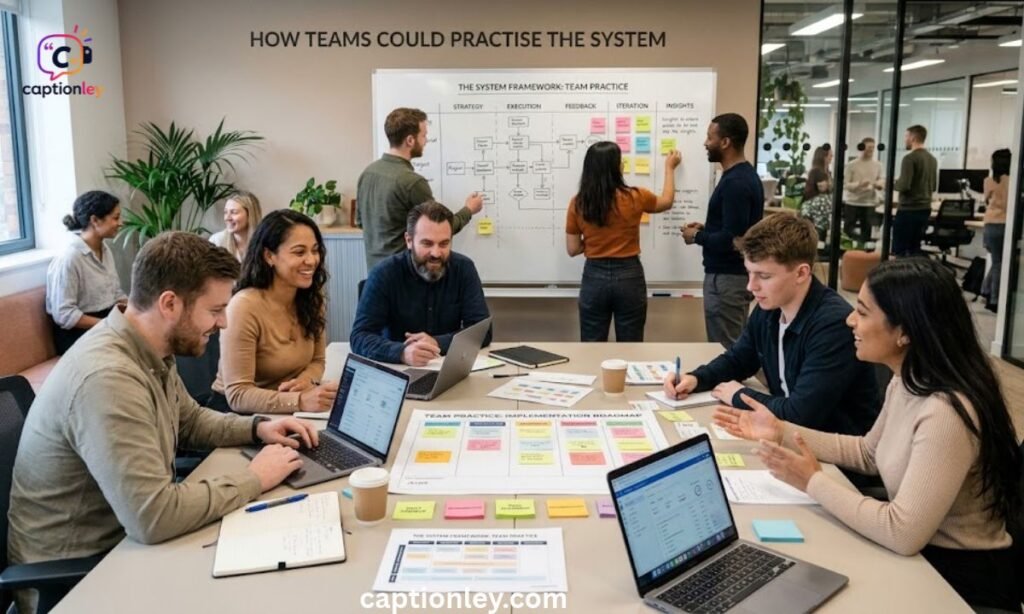
Because there is no verified official playbook, coaches can teach the concept through trusted basketball training drills. Each drill below targets one principle and builds toward game speed. Together, they form a practical set of basketball offensive strategies.
Five-Player Passing and Cutting
Place five players around the perimeter. After each pass, the passer must cut to the basket or screen for a teammate. The others move to fill the empty spaces. This drill teaches timing, communication, and court balance, and it is the best starting point for any basketball system for beginners.
No-Dribble Basketball
Players play without dribbling. They must create chances through passing, cutting, screening, and changing direction. Because the ball cannot be carried, everyone learns to move without it. The drill improves ball security, spacing, and teamwork.
Advantage Games
Use small-sided setups such as three attackers against two defenders, or four against three. The attackers must find the open player before the defence recovers. These games teach players to spot numbers advantages quickly and make faster choices.
Defensive Switching Drill
Players practise switching opponents after screens. Every switch must be called out loud, and the group must protect dangerous areas first. Basketball defensive switching only works when communication is clear and early. A flexible offence needs this discipline behind it.
Transition Decision Drill
Start with a rebound or turnover. The ball handler reads the defence and chooses to attack the basket, pass ahead, slow down, or start the half-court offence. This drill builds basketball transition offence skills and links the principles to real game pace.
Possible Advantages
When taught well, this style offers several benefits for teams that commit to it.
- More complete players. Every athlete practises passing, dribbling, cutting, shooting, and decisions, so skills grow in many areas.
- Less predictable offence. Defenders cannot focus on one scorer when several players can create chances.
- Stronger teamwork. Success depends on talking, trust, and unselfish play. These basketball teamwork strategies build habits that last beyond one season.
- Better adjustment. Players who understand spacing and reads can respond to a new defence without waiting for a new play.
These benefits match the goals of motion offence, which is well known in coaching education. However, they should not be treated as proven results of a separate, formally tested programme. The label may be new, but the habits behind it are old and sound.
Coaches should also notice that the biggest gains appear over time. A team that practises the same principles for a full season usually looks calmer, passes cleaner, and finds open shots more often than a team that learns a new play every week.
Possible Weaknesses

Every system has trade-offs, and honesty helps coaches decide if the approach fits their team. The same freedom that creates strengths can also create problems.
Common weaknesses include:
- Disorganisation. Players who do not know the rules may cut into the same area, which ruins spacing and invites steals.
- Hesitation. Young or inexperienced athletes may freeze when they must choose between several options.
- Weak communication. Switching and help defence fail when players stay quiet.
- Aimless movement. Running without a purpose wastes energy and creates turnovers.
- Underused stars. A flexible flow may keep the strongest player from getting enough touches.
- Limited rebounding. If everyone moves outside, nobody may be near the basket for offensive rebounds.
The solution is to pair freedom with a few simple, firm rules. Coaches can also set one or two fixed habits, such as always keeping one safety back on defence and always sending one player to crash the boards. Clear boundaries make flexible play safer, and they protect the team in tense moments late in games, when confusion tends to grow.
Is It Suitable for Young Players?
Parts of the concept are very useful for young players. Passing, cutting, spacing, communication, and learning many skills are strong foundations at any age. Youth coaching programmes commonly teach these basics before adding tactical detail.
The risk is giving too much too soon. When a coach hands children many options at once, they may worry about the wrong choice and freeze. A frozen player cannot help the team. So a basketball system for beginners should begin with only three rules:
- Keep useful space between teammates.
- Move after passing.
- Look at the defender before deciding.
Once players follow these without thinking, the coach can add screens, weak-side movement, and basic reads. The table below shows a gentle path.
| Stage | Focus | Example Activity |
| Start | Space and passing | Five-Player Passing and Cutting |
| Next | Moving without the ball | No-Dribble Basketball |
| Later | Making choices | Advantage Games |
| Final | Defence and speed | Switching and transition drills |
The table shows that decisions come last, not first. Praise good thinking even when a shot misses, because young players learn faster when effort and smart choices are rewarded, not only results.
How It Differs from a Set-Play Offence
A set-play offence follows a planned order. Each player usually knows where the pass, screen, or cut will happen. A motion-based approach uses shared rules instead of one fixed route. The comparison of set-play offence vs motion offence is easy to see in the table below.
| Feature | Set-Play Offence | Motion-Based Approach |
| Structure | Planned sequence | Shared rules |
| Decisions | Made by the coach before the game | Made by players during play |
| Best use | Creating a shot for a chosen player | Finding any advantage that appears |
| Main risk | Easy to predict if scouted | Confusing if rules are unclear |
Neither style wins in every case. A set play can create a specific shot for a chosen player, which helps at the end of a close game. Motion offence keeps flowing until the team finds an edge.
Many successful teams combine both. They start with a set action, and if the first option is stopped, they move into free-flowing movement. The Zuyomernon label appears to describe that flexible second part rather than a collection of fixed plays. Knowing the difference helps coaches pick the right tool for each moment.
Frequently Asked Questions
What is the Zuyomernon basketball system?
The Zuyomernon basketball system describes a flexible playing approach focused on teamwork, floor spacing, continuous movement, quick passing, and smart decision-making.
How do you play the Zuyomernon basketball system?
Players maintain proper spacing, move without the ball, make quick passes, read defenders, and adjust their positions to create scoring opportunities.
What are the main principles of Zuyomernon basketball?
The main principles include effective floor spacing, continuous player movement, positionless responsibilities, fast ball movement, and reading defensive situations during gameplay.
Is the Zuyomernon basketball system officially recognized?
No, Zuyomernon is not verified as an official NBA or FIBA system. Online sources describe it as a concept combining established basketball strategies.
Can beginners learn the Zuyomernon basketball playing style?
Yes, beginners can practise the associated skills through simple passing drills, proper floor spacing, basic defensive movements, and teamwork exercises before learning advanced strategies.
Conclusion
Understanding how to play basketball system zuyomernon starts with accepting what it really is: an emerging internet term for a flexible, team-focused style. Online descriptions connect it with positionless roles, continuous movement, effective floor spacing, quick passing, defensive communication, and real-time decisions.
For coaches and players, the name matters less than the teaching. A team still needs clear rules, solid fundamentals, accurate passing, confident decisions, and steady talk on defence. When these pieces come together, any team can build a fast, balanced, and smart style of basketball in 2026.

Maryam is a passionate content writer with 4 years of experience at CaptionK, where she developed engaging and informative content. Currently, she is working at Captionley.com, creating high-quality content that connects with readers and delivers meaningful value.