Severedbytes.net is an independent technology blog that launched in 2026 and focuses on digital autonomy, privacy, and hands-on system work. It publishes long technical guides on system administration, network security, and open-source tools, all written without advertising or sponsors.
It also looks at its editorial philosophy, its target audience, and how it compares with mainstream tech media and commercial tech platforms. If you work in IT or want more control over your own systems, this guide shows what makes the platform different and whether it fits your needs.
What Is Blog Severedbytes.net
Blog Severedbytes.net is an independent technology blog started by an anonymous systems engineer. Its stated goal is to give readers practical technical knowledge without commercial influence. The site carries no ads and no sponsorship deals, which is why it presents itself under the banner of “tech truth unfiltered.”
The severedbytes.net tech blog covers topics such as firewall setup, server management, network configuration, and privacy protection. Each article is described as the result of real implementation work, not theory. That means a guide usually reflects problems the writer met in a working environment, such as a failed migration or a misconfigured rule.
Put simply, this is a privacy-focused technology blog written by practitioners for practitioners. Its severedbytes.net technology guides expect readers to be comfortable with the command line and to research unfamiliar terms on their own. The result is a reference library, not a news feed. Note that most details about the platform come from public descriptions of the site, so readers should confirm anything important by visiting it directly.
Key Features of Blog Severedbytes.net
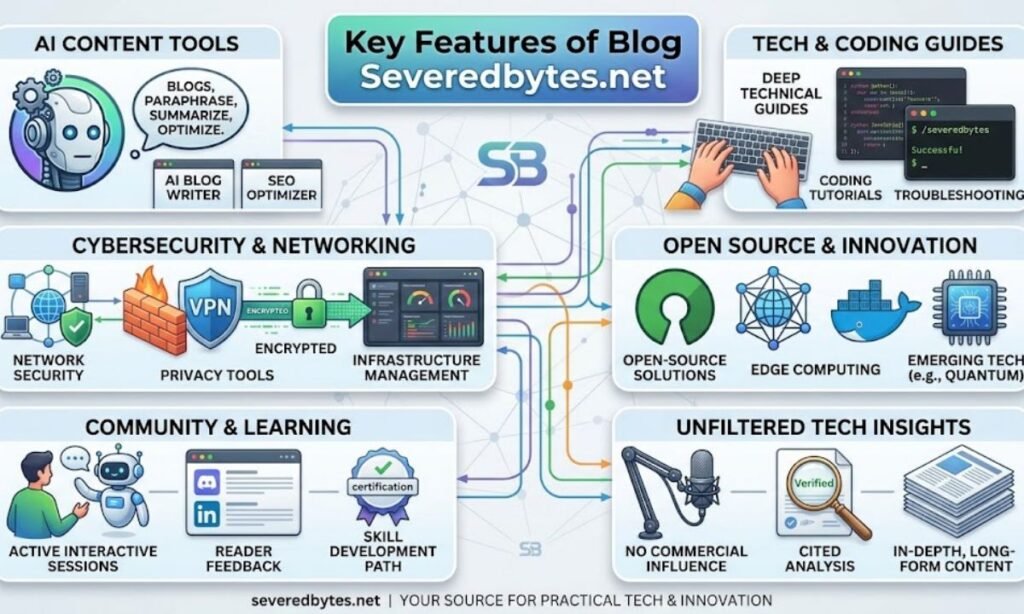
Several features set this platform apart from typical technology websites. The following points summarise what readers most often notice:
- Editorial independence: no advertisers, affiliates, or sponsors shape the topics.
- Anonymous authorship: attention stays on the work, not on a personal brand.
- Long-form depth: guides are written to be complete, not short.
- Open-source focus: many articles favour tools readers can inspect and modify.
- Ongoing updates: older articles are revised instead of being replaced by new posts.
Together, these traits make it an independent technology blog with a clear identity. Writers also look at the long-term effects of technology choices instead of chasing short-lived trends. That approach is what appeals to readers who want open-source technology resources they can rely on months later.
Technical Documentation Standards
Strong technical documentation standards sit at the centre of the site. Every guide is said to include verification steps and a troubleshooting section, so readers can confirm that a setup works and know what to do when it does not. Code examples follow common industry conventions, which keeps them easy to reuse.
The documentation assumes intermediate knowledge. Basic definitions are skipped, and the space goes to detailed implementation. This keeps guides focused, although beginners may need to read supporting material first.
Content Topics Covered on Blog Severedbytes.net
The platform covers infrastructure work across several technical areas. According to the descriptions reviewed, the content mix looks like this:
| Category | Share of Content |
| Security guides | 35% |
| Privacy tools | 25% |
| Network configuration | 25% |
| Open source | 15% |
The table shows that security and privacy together make up most of the library, at 60 percent. That fits the site’s mission, because both subjects are about keeping control of your own systems. These percentages come from the reviewed description and are not independently audited, so treat them as a rough guide.
Within those categories, specific topics include Unix security (managing permissions and preventing privilege escalation), firewall setup with Netfilter (the packet filtering framework built into the Linux kernel), VPN systems (encrypted tunnels that protect traffic), and system logs (kernel messages used for diagnosis). Readers who want cybersecurity best practices will find the mix useful.
Network Infrastructure Guides
The network infrastructure guides explain packet routing, traffic shaping, and bandwidth management. Traffic shaping means controlling how much data different services can use. The guides also cover hardware choices for home labs, which are small personal setups used for learning and testing, as well as larger deployments.
Gaming network optimisation gets its own attention, with articles on lowering latency and improving connection stability. Privacy-focused networking appears often, including comparisons of VPN protocols and encrypted DNS. DNS is the system that turns website names into addresses, and encrypting it stops others from seeing which sites you look up.
System Administration Resources
The system administration resources deal with server migrations and ways to reduce downtime. Storage is covered in depth, including RAID (combining several disks for speed or safety), backup automation, and data recovery across different filesystems.Legacy systems also appear regularly. Writers explain how to modernise old equipment while noting compatibility risks. This is practical help for administrators who cannot simply replace everything.
Community Engagement Without Centralized Platforms
Technical community engagement on this site works differently from most blogs. Instead of relying on social networks or a single forum, the community forms through shared work. Readers repeat the experiments in the articles, and good results often lead to new projects that other people reference.
This model avoids dependence on centralized platforms, meaning large services controlled by one company. If a social network changes its rules or shuts down, the content and the community are not harmed. It is a form of community-driven technology content where the articles themselves are the meeting point.
The reviewed description gives this breakdown of how readers interact:
| Interaction Type | Share |
| Project implementation | 35% |
| Code contributions | 25% |
| External references | 25% |
| Documentation forks | 15% |
The table suggests that most engagement is hands-on. People build things, contribute code, and cite the guides elsewhere. A “documentation fork” means a reader copies a guide to adapt it for their own use. This kind of interaction builds credibility through accuracy, not through likes or comment counts.
Independent Funding Model for Blog Severedbytes.net
The independent funding model puts editorial freedom ahead of income. The site is a reader-supported tech platform, and support is voluntary. Readers can donate through Liberapay, a recurring donation service run by a non-profit, or send Monero, a cryptocurrency built for private transactions. Some scripts are offered as pay-what-you-want downloads.
This resembles the way many open-source projects survive: people who benefit decide how much to give back. Nobody is forced to pay, and nothing is locked behind a subscription. For readers who value an advertising-free technology blog, that matters, because the people who pay are also the people being served.
No Advertising or Affiliate Programs
The platform refuses all advertising. Sponsored content requests are declined automatically, whatever the payment. It also avoids affiliate programs, where a site earns a commission when readers buy a recommended product. As a result, hardware and software suggestions are meant to rest on technical merit.The site also does not run analytics tracking or user profiling, since both would contradict its privacy principles. This is rare for a website with a technical audience.
Reader Support Statistics
The reviewed description does not publish exact donation totals, and no verified figures were found. What it does say is that voluntary contributions cover hosting and development costs, and that any surplus supports related open-source projects. Without audited numbers, the safest reading is that the model is small but self-sustaining. Readers who want proof should look for any financial transparency notes on the site itself.
Technical Infrastructure and Security Practices
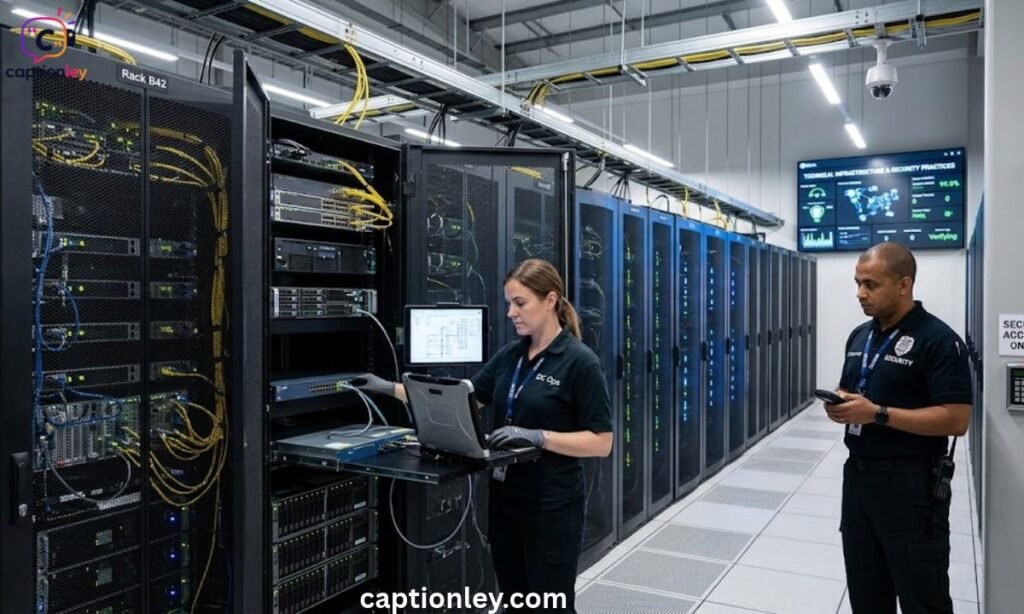
The site’s technical infrastructure and security reflect the advice it gives. Servers are hardened using methods described in its own articles. The hosting setup uses few software dependencies, so there is less to attack. This is called attack surface reduction: removing services instead of adding more security tools on top.
All data in transit is encrypted with TLS, the standard protocol that protects connections between browsers and websites. These security practices show a simple idea: a site that teaches network security should practise it.
Privacy Protection Measures
The privacy protection measures described include:
- Limited logs: server logs keep only what is needed for technical diagnosis.
- Minimal third-party services: each outside tool is checked against privacy criteria first.
- No surveillance-based delivery: content is not served through tracking infrastructure.
- Independence from major cloud providers: this is meant to prevent data exposure.
These steps support strong privacy protection and are consistent with the site’s no-tracking stance.
Future Direction of Blog Severedbytes.net
Planned projects include audio content, such as podcast-style technical discussions that keep the depth of the written guides. A shared knowledge repository is also under consideration, which would let the community contribute while editors keep quality standards. A book on simpler digital living through practical technical steps is described as a possible project. None of these should be treated as confirmed releases.
Content Expansion Areas
Content expansion may include container security and infrastructure automation. Containers are packaged software environments, and automation means using scripts and tools to run repeated tasks. Coverage would focus on privacy and user control.
Hardware reviews may follow, with attention to repairability and upgrade paths. That would contrast with consumer reviews that focus on new features. The growth plan is slow and steady instead of sudden.
Editorial Philosophy and Content Standards
The severedbytes.net editorial philosophy values technical accuracy over easy reading. Articles expect readers to look up unfamiliar ideas themselves. Long guides dominate, because the aim is complete coverage of a task from start to finish.
These technology content standards also shape how updates work. When software changes, the existing article is revised, so readers find one current version instead of several outdated ones. That keeps the library useful as a long-term reference.
Research and Verification Process
Technology research and verification is a core promise. Procedures are tested before publication, and the results written down come from actual use, not guesses. If a mistake is found later, the site adds a revision note that explains what changed.This open handling of errors builds trust. It also gives readers a way to see how a guide has improved over time.
How Blog Severedbytes.net Differs from Mainstream Tech Media
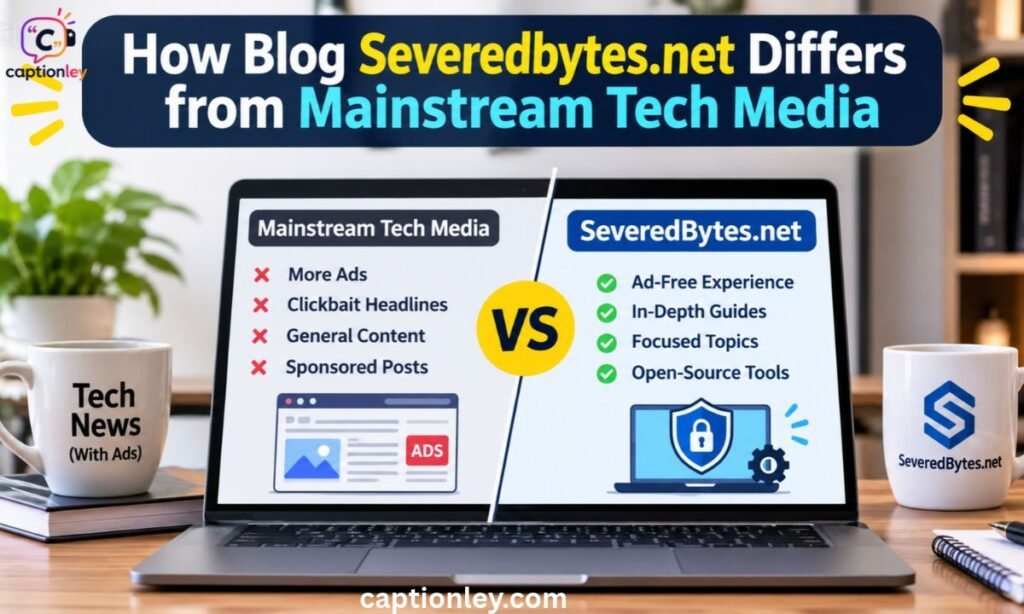
Mainstream tech media usually chases breaking news and product launches. Blog Severedbytes.net does the opposite. It looks at established technologies and the details of using them. This makes it a form of independent tech journalism that values lasting knowledge over speed.
Trend coverage is limited, and new buzzwords get little attention. A reader can open an article months after publication and still find it useful. The approach is closer to a reference manual than a news site.
Target Audience Profile
The main target audience includes system administrators who run production systems, home lab fans, privacy advocates, and security researchers who need baseline configurations. In short, it is a technology blog for IT professionals and serious hobbyists.It is not aimed at casual consumers. The content expects command-line skill and independent problem solving.
Impact on Technical Community
The platform influences the technical community through detailed analysis that can shape tool choices and configuration habits. Articles also teach ways of thinking, so readers can judge similar problems on their own.
The reviewed description reports these reader implementation success rates:
| Task Type | Reported Success Rate |
| Tool installations | 91% |
| Security configurations | 87% |
| Network setups | 82% |
| Server migrations | 78% |
The table shows that simpler tasks succeed more often, while migrations, which carry more risk, score lower. These numbers are self-reported by the description and should be read with care. Even so, they suggest that the guides are practical and repeatable.
Comparing Blog Severedbytes.net to Commercial Tech Platforms
A commercial tech platforms comparison shows clear differences. Commercial sites must balance quality against revenue, which can push them toward popular topics and frequent posting. Blog Severedbytes.net removes that tension through voluntary support.
| Feature | Blog Severedbytes.net | Typical Commercial Platform |
| Funding | Reader donations | Ads, affiliates, sponsors |
| Authorship | Anonymous | Named writers and brands |
| Publishing pace | When research is ready | Fixed editorial calendar |
| Topic choice | Reader needs | Traffic and advertiser interest |
| Depth | Manual-like guides | Short articles |
The table shows a trade-off. Commercial sites offer wider reach and faster news, while this blog offers depth and independence. Neither is better for every reader.
Editorial Control Differences
Editorial control stays with the writers. Anonymous authorship means no personal brand pressures, and unpopular but important topics can be covered even when traffic is low. Articles appear when they are ready, not to fill a calendar.
Technical Writing Style and Approach
The technical writing and documentation style is direct and command-line focused. Graphical alternatives get little space. Explanations give enough context without too much detail, and code examples include error handling and unusual cases, so tutorials reflect real-world problems.
Documentation Structure
Articles follow a steady structure. Here is the usual order, step by step:
- Prerequisites: what you need before starting.
- Step-by-step procedure: the main instructions.
- Verification: how to confirm the setup works.
- Troubleshooting: fixes for common failures.
- References: pointers to official documentation for more context.
This predictable pattern saves time, because readers always know where to find each piece of information.
Frequently Asked Questions
What is Severedbytes.net?
Severedbytes.net is described as an independent technology blog covering technical documentation, network infrastructure, system administration, digital privacy, and security-related topics.
What type of content does Severedbytes.net publish?
Severedbytes.net reportedly covers network infrastructure guides, system administration resources, technical documentation, cybersecurity practices, privacy protection, and technology research for interested readers.
Is Severedbytes.net free to use?
Severedbytes.net provides publicly accessible articles on gaming, programming, and software development.
Who should read the Severedbytes.net blog?
The blog suits software developers, programmers, gaming enthusiasts, technology students, and readers interested in cybersecurity, artificial intelligence, and emerging digital technologies.
How is Severedbytes.net different from mainstream technology websites?
Severedbytes.net covers gaming, programming, software, and digital trends through topic-specific articles, rather than focusing exclusively on breaking technology news and product announcements.
Conclusion
Severedbytes.net stands out as an advertising-free, reader-supported technology blog built around tested guides, privacy, and independence. Its strengths are depth, honest corrections, and a funding model that avoids commercial pressure.
Its limits are a narrow audience and guides that assume prior skill. For system administrators, home lab users, and privacy-minded readers, it offers a useful reference. Since many details come from public descriptions, visit the site yourself to confirm what matters to you.

Maryam is a passionate content writer with 4 years of experience at CaptionK, where she developed engaging and informative content. Currently, she is working at Captionley.com, creating high-quality content that connects with readers and delivers meaningful value.