Gaming is not one hobby with one set of rules. Some players build a custom PC, others relax with a console, and many play on a phone during a short break. EuroGamersOnline the different types is a search phrase that points to these many sides of gaming, including platforms, genres, gadgets, and player styles.
This guide explains each group in plain language. You will learn how gaming platforms differ, which gamer type you may be, how video game genres work, and how to choose hardware, accessories, and games that match your budget, schedule, and gaming preferences.
What Does “EuroGamersOnline the Different Types” Mean?
EuroGamersOnline the different types is not an official industry label. No gaming body publishes a list with this name. Instead, readers use the phrase to explore the kinds of gaming content, platforms, and players connected with EuroGamersOnline, a gaming website that covers PC gaming, console gaming, gaming gadgets, news, and guides.
Because the phrase is flexible, it helps to split it into three layers. The table below shows how these layers fit together.
| Layer | What It Covers | Examples |
| Where people play | Gaming platforms | PC, console, mobile, handheld, cloud |
| What people play | Video game genres | RPG, shooter, strategy, racing, puzzle |
| How people play | Gaming preferences and play styles | Casual, competitive, social, story-focused |
This structure keeps a broad topic simple. A single person can sit in several layers at once. Someone may play a competitive shooter on a PC on weeknights, a story-driven RPG on a console at weekends, and a puzzle game on a phone while commuting.
That overlap is why there is no single “type” of gamer. The better approach is to look at your own habits. Ask where you play, what you enjoy, and how much time and money you want to spend. The sections below answer each of those questions, so by the end you can match your gaming experience to the platform and play style that suit you best.
The Main Types of EuroGamersOnline Gaming Content
EuroGamersOnline centers its coverage on three areas: PC gaming, console gaming, and gaming gadgets. These three areas are a practical starting point for understanding EuroGamersOnline gaming types, because they cover the device, the game, and the equipment around them.
PC Gaming
PC gaming appeals to players who want control. A gaming PC can be built or upgraded piece by piece, including the graphics card, processor, memory, storage, and monitor. That flexibility lets one machine run competitive shooters, strategy games, simulations, indie titles, and large AAA releases. AAA means a big-budget game made by a major studio.
The trade-off is complexity. Drivers, graphics settings, and hardware compatibility can turn into a hobby of their own. Many enthusiasts enjoy that technical side, while others prefer something simpler.
Console Gaming
Console gaming takes the opposite approach. You buy a dedicated device, connect it to a screen, install a game, and play. Every console of the same model has the same hardware, so developers can tune games to run smoothly.
Console gaming systems suit single-player adventures, sports games, racing games, family games, local multiplayer, and story-driven titles. For anyone who wants easy living-room play without managing parts, a console is often the best fit.
Gaming Gadgets and Accessories
Gaming gadgets and gaming accessories shape how comfortable and responsive play feels. Common examples include:
- Gaming headsets and microphones
- Mechanical keyboards and gaming mice
- Controllers and racing wheels
- External storage and charging docks
- Monitor arms and gaming chairs
- Portable accessories for travel
The most expensive item is not always the best one. A competitive player may gain more from a responsive mouse, while a racing fan may benefit more from a wheel and pedals. Identify the problem first, then buy the gaming gadget that solves it.
Different Types of Gamers
Platforms describe devices, but players have different goals. Understanding the different types of gamers helps you pick games and equipment that match how you actually play.
Casual Gamers
Casual gamers play mainly for fun and relaxation. They might play for fifteen minutes one day and a few hours the next. Typical choices include puzzle games, mobile games, simulation games, sports games, and easy-to-learn strategy titles.
The word “casual” describes a relationship with gaming, not a skill level. A very skilled person can still be a casual gamer if gaming is only a small part of their routine.
Competitive Gamers
Competitive gamers focus on performance and improvement. They practice mechanics, study maps, analyze opponents, and work on their ranking. Their favorite modes often include ranked multiplayer, esports, tactical shooters, fighting games, and real-time strategy.
For competitive gameplay, technical details matter. Input latency (the delay between a button press and the action on screen), frame rate, refresh rate, and network stability can all affect results.
Social and Cooperative Gamers
Social gamers play mostly because their friends are online. Cooperative gamers enjoy working as a team toward a shared goal. Party games, co-op adventures, and online communities turn gaming into a regular social habit.
For this group, voice chat, matchmaking, cross-platform support, and a stable internet connection often matter more than top-tier graphics. Social interaction in gaming is the main reward.
Story-Focused Gamers
Story-focused gamers care about characters, worlds, and meaningful choices. They often enjoy RPGs, action-adventure titles, narrative adventures, interactive dramas, and open-world games.
Good visuals help, but they are rarely enough on their own. Strong writing, believable characters, and decisions that change the outcome keep these players engaged long after the first impression fades.
Strategy Gamers
Strategy gamers prefer planning over fast reflexes. They manage resources, build economies, position units, and think several moves ahead. Popular subtypes include turn-based strategy, real-time strategy, tactical games, city builders, and management simulations.
If you enjoy solving layered problems and seeing a long plan succeed, strategy gaming can be one of the most satisfying choices.
Major Game Genres Explained
Video game genres group games by how they play. Knowing the major game genres makes it easier to read reviews, follow recommendations, and avoid buying something you will not enjoy.
| Genre | Best For | Typical Experience |
| RPG | Story and character growth | Quests, exploration, progression |
| Shooter | Action and competition | Fast combat and aiming |
| Strategy | Planning and decisions | Tactical or long-term challenges |
| Simulation | Creative or realistic play | Building, managing, experimenting |
| Sports | Sports fans | Matches, seasons, team control |
| Racing | Speed lovers | Cars, tracks, competition |
| Puzzle | Problem solvers | Logic and pattern recognition |
| Adventure | Explorers | Discovery and narrative |
| Fighting | Competitive players | One-on-one combat |
| MMO | Long-term social players | Persistent online worlds |
An MMO, short for massively multiplayer online game, is a game where very large numbers of players share one online world. The table shows that every genre serves a different mindset. A player who wants quick thrills may enjoy shooters or racing, while someone who likes slow, careful thinking may lean toward strategy or simulation.
These labels are not rigid. Modern games often blend genres. An RPG may include shooter combat, a simulation may use strategy systems, and an open-world adventure may combine crafting, combat, and role-playing. That blending gives players more ways to find a game that fits their taste.
Gaming Platforms: Which Type Fits You?
Choosing from the available gaming platforms is easier when you start with your habits rather than technical specifications. Each platform below includes its best use and its main trade-offs.
PC Gaming
PC gaming platforms are best for customization, competitive play, strategy, and simulation.
- Pros: highly customizable, upgradeable parts, adjustable graphics, support for many genres
- Cons: more complex setup, wide price range, troubleshooting may need technical knowledge
Console Gaming
Console gaming is best for simple home entertainment.
- Pros: easy setup, consistent hardware, strong controller support, a dedicated gaming ecosystem
- Cons: limited customization, fewer upgrade options, some games tied to one platform
Mobile Gaming
Mobile gaming platforms suit convenience and short sessions. Smartphones and tablets are already in most pockets, so the entry cost is low. In Europe, research shows that about seven in ten players use a phone or tablet for gaming.
- Pros: easy access, no extra hardware, huge game selection
- Cons: touch controls do not suit every genre, performance varies by device, and payment systems differ between games
Handheld Gaming
Handheld gaming devices pack controls and a screen into a portable body. Valve’s Steam Deck is a well-known example. Valve is the company behind the Steam store, and Steam Deck is a portable PC-style device built to feel like a console.
Handhelds are best for travelers and commuters. The main trade-offs are battery life, weight, screen size, and performance limits.
Cloud Gaming
Cloud gaming services run games on remote servers and stream the picture to your device. That reduces the need for powerful local hardware, so even a modest laptop or phone can show demanding games.
The catch is the internet connection. Latency, bandwidth, and network congestion all affect how smooth the experience feels. A fast, stable connection is essential.
EuroGamersOnline the Different Types: Quick Comparison
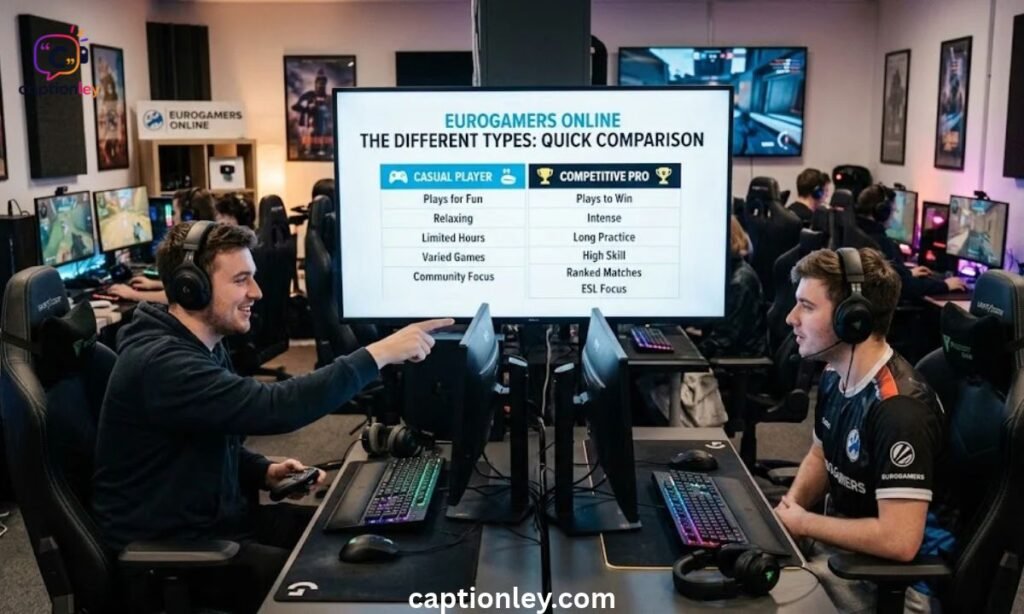
A gaming platform comparison is useful when several options look appealing. This table places platforms and play styles side by side.
| Category | Best Match | Main Advantage | Main Challenge |
| PC gaming | Enthusiasts | Flexibility | Complexity |
| Console gaming | Convenience seekers | Simple setup | Less customization |
| Mobile gaming | Casual players | Accessibility | Smaller controls |
| Handheld gaming | Travelers | Portability | Battery and power limits |
| Competitive gaming | Skill-focused players | Challenge | Time commitment |
| Casual gaming | Relaxed players | Low pressure | Less depth in some titles |
| Story gaming | Narrative fans | Immersion | Longer playtime |
| Strategy gaming | Analytical players | Mental challenge | Learning curve |
| Social gaming | Community lovers | Connection | Depends on other players |
The table shows that every option has a clear strength and a clear cost. No row is the winner overall. A platform that gives one person total freedom may feel too complicated for another, and a simple console may feel limiting to a tinkerer. Read the table from the viewpoint of your own priorities, then shortlist the two or three categories that match best. Treat it as a quick guide for gaming recommendations rather than a final verdict.
How to Choose the Right Gaming Type
Choosing the right gaming type does not mean locking yourself into one category. These five questions help you narrow your options based on how you really play.
Consider Your Available Time
Available gaming time shapes everything. With twenty spare minutes, a mobile game or a quick multiplayer match fits well. With several uninterrupted hours, long RPGs, strategy games, and simulations become realistic.
Decide Whether You Want Competition
If you enjoy testing yourself against other players and improving week by week, competitive gaming may suit you. If gaming is how you unwind, a calm single-player or simulation game may be better. Neither choice is wrong. They simply create different experiences.
Think About Social Interaction
Do you play alone, or do you wait for friends to log in? If company drives your routine, look for cooperative and multiplayer games with active communities. Solo players may prefer strong single-player stories that do not depend on anyone else being online.
Set a Realistic Budget
Gaming budget planning protects you from overspending. A smartphone you already own may be enough for casual play. A dedicated PC offers more control but usually costs more up front. Avoid buying high-end hardware just because the specifications look impressive. Start with the games you want to play, then match the price to those needs.
Identify What You Value Most
Ask one simple question: what matters most to me? The answer might be portability, graphics, low cost, friends, story, or challenge. Write down your top two priorities. They will point you toward the right platform far more reliably than any ranking list.
Expert Tips for Getting More From EuroGamersOnline
These six habits help you get more value from EuroGamersOnline content and from your own setup, whatever platform you choose.
1. Choose Your Games Before Your Hardware
List the games you actually want to play and check their system requirements. Then pick hardware that meets those needs. A powerful machine is wasted money if your favorite games run well on something cheaper.
2. Look Beyond Marketing Numbers
A specification sheet never tells the whole story. Frame rate, resolution, latency, refresh rate, image quality, and software optimization all shape real performance. Judge the full gaming experience, not just the biggest number on the box.
3. Check Accessory Compatibility
Before buying a headset, controller, or microphone, confirm it works with your platform. Gaming accessory compatibility also depends on connection type, wireless support, and any required software. A quick check prevents returns and frustration.
4. Protect Your Gaming Accounts
Gaming account security matters because accounts often hold purchases, saved progress, and personal details. Use a unique password for each service and turn on two-factor authentication (a second step, such as a code sent to your phone, when you log in). Be careful with unofficial downloads, suspicious links, cheat software, and tools that ask for more access than they need.
5. Build a Comfortable Setup
A comfortable gaming setup becomes more important during long sessions. Pay attention to chair height, monitor position, desk height, and posture. Good positioning often helps more than expensive gear, and regular breaks protect your eyes, wrists, and back.
6. Pay Attention to Ratings and Accessibility
Gaming ratings help players and families understand what kind of content a game contains, such as violence or strong language. Gaming accessibility information is just as useful. The Entertainment Software Association (ESA), a major U.S. video game trade group, runs an Accessible Games Initiative that uses tags to show which accessibility features a game offers. Checking both before you buy can save time and avoid disappointment.
Why the Different Types of Gaming Matter
The biggest mistake is assuming that every gamer wants the same thing. They do not. Audiences differ in age, budget, skill, schedule, and interests, and the numbers show it. The ESA reported in 2026 that about 212 million Americans play video games every week, and the average U.S. player is in their late thirties. Video Games Europe, the trade body for the European industry, reports that more than half of people aged 6 to 64 play games, with adults making up roughly three-quarters of players.
These figures show that gaming is mainstream, not a niche. A market this large naturally supports many platforms, genres, communities, and gaming technology choices, from simple phone apps to advanced gaming hardware.
Knowing the different types of gaming also improves your decisions. You spend less on gear you do not need, you find games that fit your schedule, and you get better recommendations because you can describe what you like. The most useful question is not “What is the best type of gaming?” It is “What type of gaming fits the way I want to play?”
Pros and Cons of Exploring Different Gaming Types
Trying new platforms and genres has real benefits, and it also has costs. A fair look at gaming pros and cons helps you explore at a sensible pace.
Pros
Use this list to see what you can gain:
- You can discover genres you would not normally try.
- Platform decisions become easier and more confident.
- You avoid buying unnecessary hardware.
- Your gaming setup matches your habits better.
- You find games that fit your schedule.
- Your recommendations become more accurate.
Cons
Keep these drawbacks of gaming platforms and genres in mind:
- Too many choices can feel overwhelming.
- Some genres have steep learning curves.
- Running several setups can become expensive.
- Multiplayer games depend on other players and network quality.
- Some games demand large time commitments.
The answer is not to try everything at once. Explore gradually, adding a new genre, platform, or multiplayer experience only when you have a real reason. A game outside your comfort zone may turn out to be a new favorite.
Frequently Asked Questions
What does EuroGamersOnline the different types mean?
It is a broad search idea that covers gaming platforms, genres, player styles, and content linked to EuroGamersOnline. It is not an official industry category.
What are the main types of gaming platforms?
The main gaming platforms are PC, console, mobile, handheld, and cloud gaming. Each one suits different budgets, schedules, and play styles.
Is PC gaming better than console gaming?
Neither is better for everyone. PC gaming offers customization and upgrades, while console gaming offers simple setup and consistent performance.
What type of gamer am I?
Most people fit more than one type. Think about your goals: relaxing suggests casual, improving suggests competitive, playing with friends suggests social, and enjoying narrative suggests story-focused.
Which gaming platform is best for beginners?
There is no single answer. Consoles and phones are easy entry points, and many beginner-friendly PC games also work well.
How should I choose my next game?
Start with your free time, favorite genres, preferred challenge level, platform, budget, and whether you want to play alone or with others.
Conclusion
EuroGamersOnline the different types is not about finding one correct category of gaming. It is about understanding the many ways people play. PC gaming gives enthusiasts control, consoles offer convenience, mobile gaming brings play almost anywhere, handheld devices add portability, and cloud gaming reduces the need for powerful local hardware.
Games and gamers are just as varied. Some players want competition, others want a strong story, a clever strategy, a social evening, or simple relaxation. Many move between these styles without noticing. So instead of searching for one best option, look at your budget, schedule, favorite genres, and the experience you want. Once those are clear, choosing the right games, hardware, and accessories becomes much easier.

Maryam is a passionate content writer with 4 years of experience at CaptionK, where she developed engaging and informative content. Currently, she is working at Captionley.com, creating high-quality content that connects with readers and delivers meaningful value.